

核心要点
2025‑26财年全国牛只屠宰量接近960万头,创下1978年以来财年屠宰量最高纪录。
昆士兰州、新南威尔士州以及维多利亚州均刷新季度牛肉产量纪录。
6月季度母牛屠宰量达到138.7万头,创下历史新高。
2025‑26财年全国牛只屠宰加工量接近960万头,为1978年以来财年最高水平。该数据体现出可供屠宰企业加工的牛只规模庞大,也反映出澳大利亚供应链具备承接历史高位屠宰量的能力,同时肉牛市场整体依旧保持相对坚挺。
该财年屠宰总量已经超出澳大利亚肉类与畜牧业协会(MLA)3月发布的肉牛行业预测报告,报告此前预测2026自然年屠宰量为945万头,当时该数值被视作近五十年来最高年度屠宰水平。
昆士兰州屠宰加工量位居全国首位
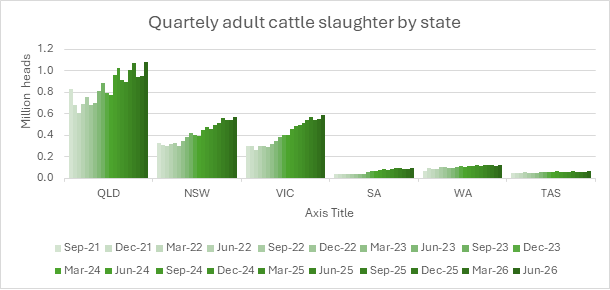
昆士兰州是6月季度屠宰量增长的主要推动力,该州屠宰108.3万头牛,占全国总屠宰量的43%。环比3月季度上涨13.9%,较去年同期提升7%。这是昆士兰州2015年以来表现最好的6月季度,也是该州十余年来季度屠宰量最高水平之一。
新南威尔士州屠宰量达57.25万头,同比增长11.7%;维多利亚州屠宰58.7万头,同比上涨8.8%。
牛肉产量表现更为亮眼。昆士兰州产出35.5529万吨,新南威尔士州17.1257万吨,维多利亚州17.1059万吨。三州均创下1972年有统计以来的季度牛肉产量新高,同时各自刷新财年产量纪录。
东部三大主要屠宰加工州同步创下纪录,说明肉牛供给增长具备广泛基础。
上半年屠宰量依旧处于高位
正如国家畜牧报告系统(NLRS)周度屠宰数据所呈现,澳大利亚统计局公布的2026年前六个月全国屠宰量较2025年同期高出6.9%。
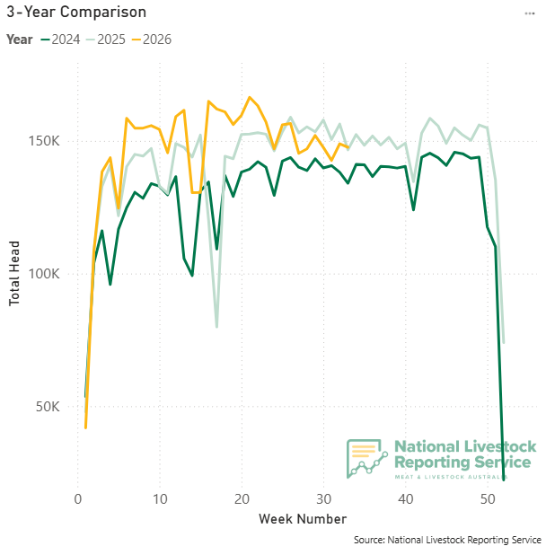
不过周度屠宰量已经开始回落。国家畜牧报告系统数据显示,上半年大部分时间屠宰量均高于2025年同期,但自6月末开始,全国屠宰加工量平均较去年同周下降约2%。
出口贸易环境趋于复杂,中国大陆与韩国的保障措施配额现已用尽。预计部分澳大利亚牛肉将转向日本、美国以及东南亚等市场,而并非会造成基本面需求萎缩。
母牛出栏量创下新高
6月季度母牛屠宰量达到138.7万头,创下1972年以来最高水平。母牛占牛只总屠宰量的55%,为2021年6月之后季度母牛屠宰占比的最高值。
母牛出栏高峰具备显著的季节性特征。大量牛群在春季配种,秋季开展孕检,空怀、老龄以及生产性能低下的母牛会在冬季来临前被淘汰。此举可以避免在牧草长势差、补饲成本高的时段饲养无生产价值的母牛,因此5‑6月母牛供给量走高。
国家畜牧报告系统近期周度数据显示,该趋势正在缓和。伴随全国整体屠宰量回落,母牛屠宰量已从5月的峰值逐步下降。
信息来源:澳大利亚肉类与畜牧业协会高级市场信息分析师埃米利亚诺·迪亚兹
澳大利亚肉类及畜牧业协会(MLA)不对本刊物所载任何信息的准确性、完整性及时效性作出任何保证。用户使用或依赖本刊物任何内容,风险自行承担;因使用或依赖相关信息所造成的任何损失与损害,MLA概不承担任何责任。未经MLA事先书面许可,本刊物任何内容不得擅自转载、复制。凡使用MLA刊物、报告及相关信息,均须遵守MLA市场报告及信息使用条款。
消息来源:MLA
What the June quarter slaughter data says about cattle supply
Key points
National cattle slaughter reached almost 9.6 million head in 2025–26, the highest financial-year total since 1978.
Queensland, NSW and Victoria all set quarterly beef production records.
Female slaughter reached a record 1.387 million head in the June quarter.
Nearly 9.6 million cattle were processed nationally in 2025–26, the highest financial-year total since 1978. The result highlights the scale of cattle available to processors and the capacity of the Australian supply chain to handle historically high throughput while cattle markets have remained comparatively strong.
The financial-year total has already exceeded the scale outlined in MLA’s March Cattle Industry Projections, which forecast 9.45 million head for the 2026 calendar year. At the time, that was expected to be the highest annual slaughter result in almost five decades.
Queensland leads national throughput
Queensland drove much of the June-quarter increase, processing 1.083 million head, or 43% of the national kill. This was 13.9% higher than the March quarter and 7% above the same quarter last year. It was Queensland’s strongest June quarter since 2015 and one of the state’s largest quarterly slaughter totals in more than a decade.
NSW slaughter reached 572,500 head, up 11.7% year-on-year, while Victoria processed 587,000 head, up 8.8%.
Beef production was even stronger. Queensland produced 355,529 tonnes, NSW 171,257 tonnes and Victoria 171,059 tonnes, with all three states recording their highest quarterly beef production in the available series since 1972. Each also set a new financial-year production record.
The fact that all three major eastern processing states reached records at the same time highlights how broad-based the lift in cattle supply has been.
First-half slaughter remains ahead
As the NLRS weekly slaughter figures have been showing, national slaughter released by ABS for the first six months of 2026 was 6.9% higher than the same period in 2025.
However, weekly slaughter has started to moderate. NLRS figures tracked above 2025 levels through much of the first half, but since the end of June national throughput has averaged around 2% below the corresponding weeks last year.
The export environment has become more complex, with safeguard quota volumes for Mainland China and Korea now filled. This is expected to redirect some Australian beef towards markets including Japan, the United States and South-East Asia rather than necessarily reduce underlying demand.
Female turn-off reaches record
The June quarter also recorded the highest number of female cattle slaughtered since 1972, at 1.387 million head. Females accounted for 55% of total cattle slaughter, the highest quarterly female slaughter rate since June 2020.
This reflects a strong seasonal element to female turn-off. With many spring-joining herds, pregnancy testing occurs through autumn, with empty, older or lower-performing cows then culled before winter. This avoids carrying unproductive females through a period of slower pasture growth and higher supplementary feed requirements, lifting female supply through May and June.
More recent NLRS weekly data suggest that trend is easing, with female slaughter gradually declining from its May peak alongside the broader moderation in national throughput.
Attribute to: Emiliano Diaz, MLA Senior Market Information Analyst.
MLA makes no representations as to the accuracy, completeness or currency of any information contained in this publication. Your use of, or reliance on, any content is entirely at your own risk and MLA accepts no liability for any losses or damages incurred by you as a result of that use or reliance. No part of this publication may be reproduced without the prior written consent of MLA. All use of MLA publications, reports and information is subject to MLA’s Market Report and Information Terms of Use.
Source:MLA

