

核心要点
春季上市量增加,对小牛价格形成下行压力。
补栏买家更偏好阉公牛,而非母牛犊。
上市量减少,叠加降雨重现,推动10月行情回暖。
春季牛只供应增加,使得澳大利亚肉牛市场出现明显分化,买家需求成为决定牛只保值能力的关键因素。
截至9月末的四周内,纳入行情指标统计的全国牛只数量上涨52%,同期小牛价格大幅回调。
新南威尔士州的供应量增幅最大,春季干旱天气令部分养殖户不愿继续饲养体重较轻的牛只以等待增重。
不过价格承压程度并不均衡。用于补栏的母牛犊价格跌幅最大,而市场对补栏阉公牛和体重更大牛只的需求依旧旺盛。
补栏户偏爱阉公牛
全国一岁补栏母牛犊行情指标从9月8日的477澳分/公斤活重,下跌20%,至9月28日的384澳分/公斤活重。同期一岁补栏阉公牛指标下跌10%。
价差持续拉大,清晰体现补栏需求集中的品类。
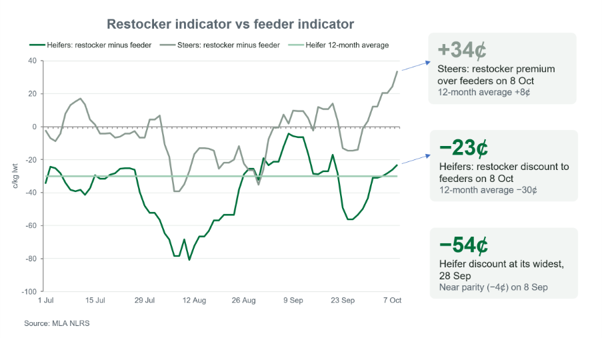
10月8日,补栏阉公牛交易价格比育肥阉公牛高出34澳分/公斤,远高于12个月约8澳分/公斤的平均溢价水平。
如此高的溢价并不常见。过去12个月里,补栏阉公牛溢价超过34澳分/公斤的交易日仅占约6%。
公母牛之间的价差差距进一步拉大。
目前补栏阉公牛价格较补栏母牛犊高出约104澳分/公斤,而12个月平均溢价为88澳分/公斤。与之相对,育肥阉公牛比育肥母牛犊贵47澳分/公斤,基本符合长期价格规律。
这表明,集中育肥场对母牛犊与阉公牛的定价逻辑仍和往常基本一致。
行情变动主要来自补栏养殖户:他们争相采购阉公牛,但对母牛的采购态度更为谨慎。
需要较长饲养周期的轻型母牛犊受季节风险影响尤为突出,而阉公牛以及体重更大、可直接送入育肥场的牛只更受市场追捧。
供应回落,价格随之反弹
随着牛只上市量下降,澳大利亚南部部分地区迎来降雨,市场行情开始回暖。
截至10月8日当周,纳入指标统计的全国牛只数量降至20766头,约为9月末峰值40558头的一半。新南威尔士州与昆士兰州的公共假期也是本次数量下降的原因之一。
自9月触底以来,补栏母牛犊和阉公牛价格分别回升8.5%、8.4%。
昆士兰州引领本轮行情复苏,得益于上市牛只减少以及跨州采购需求回升。
本周达尔比拍卖市场的上市量减少1300头,中等及大体重一岁阉公牛、大体重育肥母牛犊价格走强。
行情能否持续是接下来的考验。降雨与饲草供应仍是影响采购商信心的核心因素,母牛品类尤为明显。
在市场对季节条件的信心提升前,当前市场大概率继续偏好能够快速育肥或尽早出栏的牛只。
内容供稿:埃米利亚诺·迪亚兹,澳大利亚肉类及畜牧业协会(MLA)高级市场信息分析师
信息发布于2026年10月9日,发布时内容准确无误。
澳大利亚肉类与畜牧业协会(MLA)不对本刊物所载任何信息的准确性、完整性及时效性作出任何保证。用户使用或依赖本刊物任何内容,风险自行承担;因使用或依赖相关信息所造成的任何损失与损害,MLA概不承担任何责任。未经MLA事先书面许可,本刊物任何内容不得擅自转载、复制。凡使用MLA刊物、报告及相关信息,均须遵守MLA市场报告及信息使用条款。
消息来源:MLA
Why restockers are favouring steers this spring
Key points
Increased spring supply placed downward pressure on young cattle prices.
Restocker demand is favouring steers over heifers.
Lower yardings and renewed rainfall supported a recovery in October.
The spring increase in cattle supply has created a clear divide in the Australian cattle market with buyer demand increasingly determining which cattle are holding their value.
National cattle numbers contributing to the indicators increased 52% over four weeks to late September, coinciding with a sharp correction in young cattle prices.
NSW recorded the largest increase in supply as dry spring conditions reduced the incentive for some producers to retain lighter cattle for further weight gain.
However, the pressure has not been evenly distributed. Restocker heifers have recorded the steepest price falls, while demand for restocker steers and heavier cattle has remained considerably stronger.
Restockers favour steers
The National Restocker Yearling Heifer Indicator fell 20% from 477¢/kg liveweight (lwt) on 8 September to 384¢/kg lwt on 28 September. The Restocker Yearling Steer Indicator declined 10% over the same period.
The widening price spreads provide a clearer indication of where restocker demand is concentrated.
On 8 October, restocker steers traded at 34¢/kg more than feeder steers and were well above the 12-month average premium of approximately 8¢/kg.
A premium of this size is relatively uncommon. Over the past 12 months, the restocker steer premium has exceeded 34¢/kg on only around 6% of trading days.
The difference between sexes is even more pronounced.
Restocker steers are currently around 104¢/kg above restocker heifers, compared with a 12-month average premium of 88¢/kg. In contrast, feeder steers are 47¢/kg above feeder heifers, broadly in line with the longer-term price relationship.
This suggests lot feeders are continuing to price heifers relative to steers much as they normally would.
The larger adjustment has come from restockers who are competing strongly for steers, while remaining more cautious about purchasing females.
Lighter heifers requiring a longer carrying period remain particularly exposed to seasonal risk, while steers and heavier, feed-ready cattle are attracting stronger competition.
Supply eases and prices respond
The market has begun to recover as cattle numbers have declined and rainfall has reached parts of southern Australia.
National indicator cattle numbers fell to 20,766 in the week ending 8 October, around half the late-September peak of 40,558 head. However, public holidays in NSW and Queensland contributed to the decline.
Since reaching their September lows, restocker heifer and steer prices have recovered 8.5% and 8.4% respectively.
Queensland has led the recovery, supported by fewer cattle and renewed interstate buying.
At Dalby saleyard this week, supply fell by 1,300 head, while medium and heavy yearling steers and heavier feeder heifers recorded stronger prices.
The next test will be whether the recovery can be sustained. Rainfall and feed availability remain central to buyer confidence, particularly for females.
Until seasonal confidence strengthens, the current market is likely to continue favouring cattle that can be finished or turned off sooner.
Attribute content to: Emiliano Diaz, MLA Senior Market Information Analyst
Information is correct at time of publication on 9 October 2026
MLA makes no representations as to the accuracy, completeness or currency of any information contained in this publication. Your use of, or reliance on, any content is entirely at your own risk and MLA accepts no liability for any losses or damages incurred by you as a result of that use or reliance. No part of this publication may be reproduced without the prior written consent of MLA. All use of MLA publications, reports and information is subject to MLA’s Market Report and Information Terms of Use.
Source:MLA

