

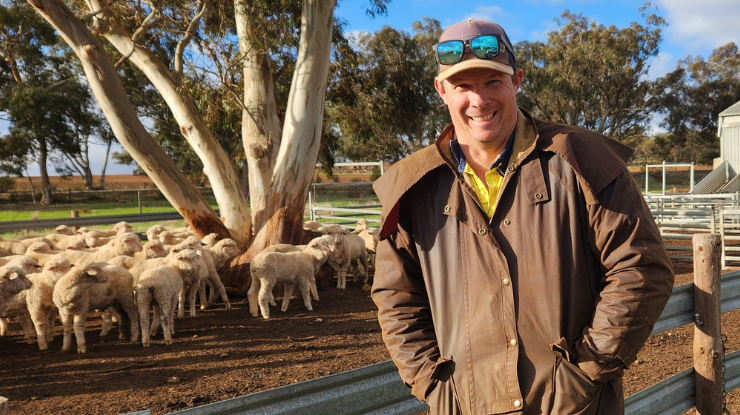
南澳大利亚州中北部养殖户戴维·克拉克,经营克拉里斯格兰牧场。
南澳中北部的牧羊养殖户克拉克家族,从初步试水开始逐步扩大电子耳标识别(eID)的应用范围,优先贴合自身核心需求,比如适配种植农事节奏、灵活管控羊群。
克拉克家族在维拉巴拉至哈蒙德之间跨度约50公里的范围内,拥有五处牧场,自繁自养美利奴羊群。
伊恩·克拉克与苏珊·克拉克自1988年起担任农场管理者,其子戴维于2013年全职加入家族农牧业务。
种植业收入占农场总收入的四分之三以上,其余收入则来自牧羊产业。
农场概况简介
经营主体:戴维、克洛伊、伊恩、苏珊・克拉克,克拉里斯格兰牧场,南澳州维拉巴拉、哈蒙德
土地面积:1600 公顷
经营项目:自繁自养美利奴羊群,基础母羊存栏 500–650 头;种植业占地 1100 公顷,种植谷物、豆类及油菜
草场类型:种植大麦与野豌豆
土壤条件:类型多样,从重质红黏土至壤土均有分布
年均降雨量:290–450 毫米
羊群管理
羊群养殖完全配合种植农事节奏开展。全年大部分时间,羊群分为两大群放养;进入产羔期后,再拆分为小群精细化管理。
怀多羔的母羊分群控制在100头以内,怀单羔的母羊则统一编为一群,规模最多可达300头。
母羊通常在三、四月配种,配种后80至100天进行孕检扫描。
克拉克家族在参加北上部农牧系统组织的资讯宣讲会后,于2021年开始给后备母羔羊佩戴电子识别耳标。
他们采用循序渐进的方式推行电子耳标应用:先从简易基础用法起步,后续数年再逐步增设优化目标,并配套完善相关数据采集工作。
引入电子识别耳标(eID)的缘由
克拉克家族制定了多项改良目标,而电子耳标(eID)不仅提供数据支撑,也助力目标落地,具体包括:
孕检准确率与产羔率提升(尤其将空怀母羊比例控制在5%以内)
实现个体羊只精准识别,便于分时分群、灵活组群
多年持续追踪每只母羊的繁殖生产表现
提高羔羊生长速度
最大化利用现有饲草资源
尽管克拉克家族2021年就率先给后备母羔羊佩戴了电子识别耳标,但正式的基础数据采集直到2022年才启动。当年他们购置了手持识读器,开始对母羊开展孕检工作。
2023年购入称重设备后,他们开始记录母羊体重数据,2024年末又将阉公羔羊纳入体重采集范围。
目前他们采集的数据包含:
孕检结果(多羔/单羔/空怀)
母羔羊产羔情况(双羔/单羔)
母羔羊断奶体重及不定期抽检体重
蝇蛆病发病情况与粪便污毛等级
出生所在牧场地块
电子识别耳标配套设备
数据通过加拉格尔HR4手持识读器,以及安装在组合式固定架上的无线称重地磅采集。
数据经由蓝牙传输至手机端的加拉格尔牲畜性能管理应用。这款应用具备称重显示器的同类功能,可省去高额前期硬件投入,但需支付月度订阅费用。
他们选购这套设备主要依据:
所需功能匹配
中端价位水平
安装设置简易、实用够用
前期投入成本更低
戴维建议采购设备前多对比不同品牌。
他表示:“务必综合考量整套系统各配件的优劣,不同品牌的设备往往难以兼容混用。”
数据采集实用技巧
除孕检之外,其余数据采集均结合日常农事同步开展。母羊产羔情况在打标时记录,通过电子耳标识别,分别登记单羔、双羔羊群信息;体重数据则在断奶和剪毛环节同步采集。
数据采集并未额外增加人工工作量。所有数据按出生年份录入Excel表格,分年龄段建立母羊数据档案。
日常可在圈舍内,从加拉格尔应用中调取分群清单,按需导出,指导人工分群作业。
戴维表示,初期安装和使用电子耳标设备的体验良好,当地经销商也提供了完善的售后支持。
称重数据采集的主要局限在于:家族牧场分布分散、间距较远,而称重设备固定安置在剪毛棚主圈舍,无法灵活移动使用。
羊群管理更简便高效
电子识别耳标(eID)让农牧养殖管理适配种植农事节奏,流程更精简高效。
在启用电子耳标之前,从孕检到产羔全程都需要羊群分群隔离饲养。
这让剪毛、转场放牧等日常管理工作变得繁琐,也更耗费工时。
如今通过eID可在孕检时直接区分怀双羔、单羔的母羊,孕检结束后便能将所有母羊合群统一放养,大幅简化日常管理。
待到产羔前三至六周,再精准拆分双羔、单羔母羊分群饲养,有效提升产羔成效。
提升产羔率
2019 年引入孕检扫描的核心目的是提升产羔率。
借助电子识别耳标,可轻松识别空怀后备母羊;这类母羊若首次孕检空怀,可再留养试配一年,若再次空怀再出售。而经产母羊一旦检出空怀,则直接淘汰出栏。
推行孕检后还发现,孕检受孕率与实际产羔率之间存在 40% 的差值损耗。
利用电子识别耳标按受孕状态简化母羊管理,正在逐步缩小这一差距。
条件允许时,会给怀双羔母羊进行补饲,从与单羔母羊分群开始,一直饲喂到羔羊 10–12 周龄。
持续记录每只母羊的受孕状态,让戴维能够为每只母羊建立终身繁殖性能档案,以此辅助做出留种或淘汰的决策。
产过双羔的母羊可比单羔母羊留养更久;除后备母羊外,其余空怀母羊一律即时淘汰。
各个年龄段中,只产单羔的母羊都会面临更高的淘汰筛选力度。
过去五年,农场整体产羔率提升了约 20%。成效主要来自:及时淘汰无生产效益的空怀母羊、延长双羔母羊留种繁育年限,以及对双羔母羊进行营养管控,提高胎儿存活率。
体重增长监测
戴维开始记录每日平均增重,用数据筛选出长势不佳的母羔羊,尽早淘汰处理,不必留到青年羊阶段。
自2024年起,所有羔羊均佩戴电子识别耳标,全程监测体重增长情况。
采集的数据用于在圈舍内甄别羊只,尤其在干旱缺草年份:筛选出能快速达到出栏体重、可即时售卖的个体;其余则维持低营养饲喂,等到当年草料条件好转后再育肥出栏。
戴维还利用体重数据监控体型过大羊只的占比,这类羊只容易在剪毛等环节造成管理难题。
依托电子耳标数据做决策,能够合理分配饲草资源、提升收益并简化日常管理。
羊群进圈时,他都会用手持识读器筛查粪便污毛等级高、或是曾患蝇蛆病接受过治疗的母羊,将其列入后续淘汰名单。这让决策依据转为数据支撑,不再只靠肉眼外观判断和年龄筛选。
在环境恶劣的年份,饲草精细化管理直接决定养殖收益,这套做法的价值尤为突出。
未来规划
戴维已完成两批羊群种质基因DNA检测,并依据检测结果,开始针对眼肌厚度和膘肥度进行选育,以此提升羊群抗逆性。
后续还将计划对不同产羔类型的羊只,登记断奶体重与断奶后体重,从而更精准评估饲料转化率。
经验总结
从小处着手、力求简易。初期只采集少量数据,不要一开始就给自己造成过大负担。
不要羞于向专业顾问请教数据管理与应用的建议。合理重视自身时间成本,才能看清顾问带来的价值,他们能高效完成相关工作。
对原始数据做重大修改前,务必做好备份,避免人为造成办公数据故障。
记得向设备厂商索取与电子耳标配套的索引档案文件,这项务必落实到位。
本案例研究由南澳大利亚州政府电子耳标优势项目牵头编制,并得到澳大利亚肉类与畜牧业协会、澳大利亚羊毛创新协会南澳推广部门的支持。
消息来源:MLA
Targeted ewe management lifts lambing by 20%
Mid North SA sheep producer David Clarke at ‘Clarisglen’.
Mid North SA sheep producers, the Clarke family, have scaled up their use of electronic identification (eID) from a simple start to make sure it met their key needs first – such as flexibility in managing sheep around their cropping program.
The Clarkes run a self-replacing Merino flock on five properties, spread across approximately 50km between Wirrabara and Hammond.
Ian and Susan Clarke have been farm managers since 1988, with their son David coming into the business full-time in 2013.
Their cropping program accounts for more than three-quarters of their farm income, with the remainder from the sheep.
FARM SNAPSHOT
Name: David, Chloe, Ian and Susan Clarke – ‘Clarisglen’, Wirrabara and Hammond, SA
Area: 1,600ha
Enterprise: Self-replacing Merino flock based on 500–650 ewes and a cropping program of 1,100ha with cereals, legumes and canola
Pastures: Sown barley and vetch
Soils: Variable – heavy red clays to loams
Rainfall: 290–450mm
Flock management
Their sheep are managed to fit around the cropping program. The flock is run as two big mobs for most of the year, then managed as smaller mobs for lambing.
Mob size is reduced to fewer than 100 for ewes bearing multiples, while single-bearing ewes are generally run as a single mob of up to 300.
Ewes are typically mated in March and April and are pregnancy scanned 80–100 days post-joining.
The Clarkes began tagging ewe lambs with eID in 2021, after attending an information day organised by the Upper North Farming Systems group.
They approached eID adoption from the perspective of starting simply, then slowly adding improvement goals and associated data collection over a few years.
Why eID was introduced
The Clarkes had a list of improvements which have been supported by data from eID. These included:
higher scanning and lambing rates (in particular, getting dries to below 5%)
reliable individual animal identification, to enable boxing/splitting mobs at different times
reliable tracking of individual ewes’ breeding performance across multiple years
fast growth rates in lambs
best use of available feed.
Although they first applied eID tags to ewe lambs in 2021, basic data collection didn’t commence until 2022, when the Clarkes purchased a stick reader and began pregnancy scanning ewes.
After they purchased weighing equipment in 2023, they began collecting weight data for ewes, followed by wether lambs in late 2024.
They collect data on:
pregnancy scanning results (multiple/single/dry)
birth status of ewe lambs (twin/single)
ewe lamb weights at weaning and opportunistically at other times
occurrence of flystrike and high dag scores
paddock of birth.
eID equipment
Data is collected using a Gallagher HR4 stick reader and a set of wireless load bars installed on a Combi Clamp handler.
Data is sent via Bluetooth to a Gallagher animal performance application installed on a smart phone. The app has similar functionality to a scale indicator without the upfront cost, however there is a monthly subscription fee for the app.
The equipment they purchased was chosen based on:
the desired functionality
mid-range price
simple set-up that gets the job done
lower upfront cost.
David recommends assessing different brands before purchasing equipment.
“It’s worthwhile considering the merits of all the components of the system you intend to use as it can be difficult to integrate components from different brands,” he said.
Data collection tips
Data collection outside of pregnancy scanning is arranged around other activities. Birth status of ewes is collected at marking, by reading eID tags of singles and twins in their separate mobs. Weight data is collected at weaning and shearing.
Collecting data has not created any additional labour requirements. Data is transferred into excel spreadsheets on a ‘year of birth’ basis, creating sets of data for different age groups for ewes.
Data in the form of drafting lists is also stored and retrieved from the Gallagher app in the yards as needed, to guide manual drafting.
David said his experience of initially setting up and using the eID equipment was pretty good and he received good after-sales support from his local reseller.
A major limitation with collecting weight data has been the distances between the Clarkes’ grazing properties, as the weigh equipment is fixed at the main yards at the shearing shed.
Easier flock management
eID streamlines livestock management around the demands of their cropping program.
Prior to implementing eID, groups had to be kept separate from scanning through to lambing.
This made livestock management tasks, such as shearing or moving between paddocks, more complicated and time consuming.
Now that they use eID to identify ewes as twin or single bearing at scanning, all ewes can be boxed together into one big mob immediately following scanning for greater ease of management.
They can then be reliably separated three-to-six weeks prior to lambing into twin and single mobs for better lambing outcomes.
Increasing lambing percentage
A key driver for introducing pregnancy scanning in 2019 was to increase lambing percentage.
eID subsequently enabled dry maiden ewes to be easily identified and potentially kept for a further year before being sold if they scan dry a second time, as opposed to older ewes which are sold off following being identified as dry.
Implementing pregnancy scanning also revealed a 40% loss between scanning rate and lambing percentage.
Using eID to simplify the management of ewes based on their pregnancy status is closing this gap.
Twin-bearing ewes are given supplementary feeding where possible, from the time they are separated from singles up until lambs are 10–12 weeks old.
Keeping records of individual pregnancy status has enabled David to build up a lifetime reproductive performance profile for each ewe – which aids keep/cull decisions.
Ewes that have twinned are retained to an older age than singles, while dries (apart from maiden ewes) are immediately removed.
Ewes that have only born singles have a higher culling pressure applied at all age stages.
Lambing percentage has improved by about 20% over the past five years. This has been achieved by removing unproductive dry ewes, as well as retaining and breeding from twin-bearing ewes for longer and managing the nutrition of twin-bearing ewes to improve foetal survival rate.
Monitoring weight gain
David began recording average daily weight gain to provide data to identify poorer performing ewe lambs for earlier removal as lambs rather than hoggets.
Since 2024, all lambs have been eID tagged and monitored for weight gain.
Data collected is used to identify which animals in the Clarkes’ containment yards, especially in difficult dry times, can be pushed to finishing weight quickly and sold, versus those that will be put onto maintenance and finished later in the year when better feed is likely to be available.
David is also using weight data to monitor for the prevalence of oversized animals – which can pose a management issue, such as at shearing.
Using the eID data to make these decisions allows him to allocate feed resources effectively, maximising profit and simplifying management.
He also uses the wand reader whenever sheep are in the yards to identify ewes with high dag scores or which are being treated for flystrike and these go on a list for subsequent culling. This ensures decisions are based on data, not just visual classing or age.
This has particular significance in difficult seasons when efficient management of feed becomes critical for profitability.
Future plans
David has done two rounds of flock profile DNA testing and, based on the results, has begun to apply selection pressure for eye muscle depth and fat to improve stock resilience.
Recording weaning weight and post-weaning weights against birth status may also be undertaken in future to better assess feed conversion efficiency.
Lessons learnt
Start small and simple. Collect a small amount of data to begin with – don’t swamp yourself.
Don’t be afraid to get data management/use advice from a consultant. Value your own time properly to understand the value a consultant can bring. They can complete tasks quickly.
Always create a backup copy of original data before making significant changes. Avoid creating self-inflicted, office-based problems.
Remember to get the BucketFile that accompanies your eID tags from the manufacturer. Tick that box.
This case study was developed as an initiative of eID Advantage Program from the Government of South Australia, supported by MLA and AWI Extension SA.
Source:MLA

