

核心要点
2025年澳大利亚山羊屠宰量达到405万头,同比增长18%。
山羊肉产量和出口量均创下历史新高,出口量达到61,766吨装运重量,出口额达4.64亿澳元。
美国仍是澳大利亚最大的山羊肉出口市场。
2025年,澳大利亚山羊肉行业继续保持增长势头并屡破纪录,创纪录的产量、屠宰量和出口量支撑了国内及国际市场的更强供应能力。这些趋势在澳大利亚肉类及畜牧业协会(MLA)最新发布的《全球山羊概况》中得以概述,该报告为生产者、加工商、出口商及供应链相关方提供了一份聚焦澳大利亚山羊肉的行业报告。
产量与屠宰量
2025年,澳大利亚山羊屠宰量同比增长18%,达到405万头,创下历史最高纪录。维多利亚州加工量最大,为174万头;其次是昆士兰州(106万头)和新南威尔士州(105万头)。尽管南澳大利亚州和西澳大利亚州仍是较小的加工州,但两州均实现了强劲的同比增长,分别增长119%和112%。
屠宰量的增长支撑了又一个产量创纪录的年份。2025年,澳大利亚山羊肉产量达到63,672吨(胴体重量),超过了2024年创下的上一纪录。自2020年以来,在持续有利的季节条件、更强劲的山羊供应、加工能力扩大以及贸易回报改善的支撑下,产量增长了四倍。
出口继续推动市场发展
2025年,出口仍是该行业的关键驱动力。澳大利亚山羊肉出口量达到创纪录的61,766吨(装运重量),比2024年创下的上一纪录增长20%。出口额也达到4.64亿澳元的新高,比上一年度的纪录高出28%。根据联合国粮农组织的数据,在全球范围内,澳大利亚仍然是山羊肉的小型生产国,但是最大的出口国,2024年占全球山羊肉出口总量的61%。
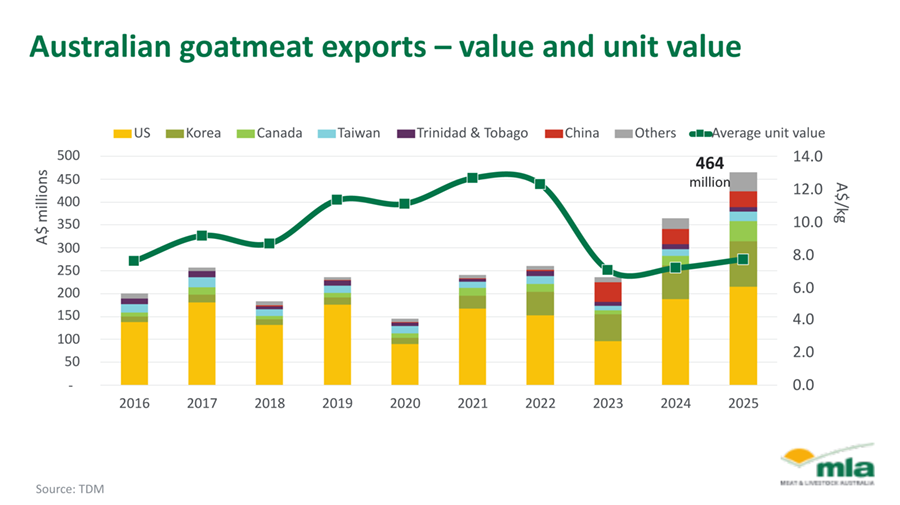
美国仍然是澳大利亚最大的山羊肉出口市场,2025年进口量为29,649吨装运重量(占出口总量的48%)。虽然美国仍是主要出口目的地,但由于替代市场的强劲增长,出口正变得更加多元化。韩国是澳大利亚第二大市场,出口量同比增长23%,达到10,638吨。中国大陆以5,449吨保持第三大市场地位,而加拿大在2024年增长89%后,以4,973吨成为第四大市场。
国内市场呈现逐步发展态势
虽然出口占据了澳大利亚山羊肉产量的大部分,但国内市场也在发展之中。山羊肉在澳大利亚家庭烹饪中仍然占比较小,与其他蛋白肉类相比,其认知度和可获得性较低。然而,过去五年产量的增加改善了国内供应情况,有超过10,000吨(胴体重量当量)的山羊肉留存在澳大利亚国内。山羊肉在零售和餐饮服务渠道中供应的持续稳定,正逐步支持着国内市场的发展。
国内机遇与澳大利亚日益增长的多元文化人口及社区密切相关,在这些社区中,山羊肉已是其既有饮食传统的一部分。山羊肉仍然与慢炖湿烹方法、文化菜肴以及消费者对健康、可持续和差异化蛋白选择的兴趣紧密相连。
关于产量、屠宰量、出口、主要市场、国内利用及消费趋势的更多详细信息,请参阅MLA最新发布的《全球山羊概况》。
信息来源:澳大利亚肉类及畜牧业协会(MLA)高级市场信息分析师 埃米利亚诺・迪亚兹
数据截至 2026 年 5 月 27 日发布当日。
澳大利亚肉类及畜牧业协会(MLA)不对本刊物所载任何信息的准确性、完整性及时效性作出任何保证。用户使用或依赖本刊物任何内容,风险自行承担;因使用或依赖相关信息所造成的任何损失与损害,MLA概不承担任何责任。未经MLA事先书面许可,本刊物任何内容不得擅自转载、复制。凡使用MLA刊物、报告及相关信息,均须遵守MLA市场报告及信息使用条款。
消息来源:MLA
Goat industry beats all metrics: New 2026 Goatmeat Snapshot
Key points
Australian goat slaughter reached 4.05 million head in 2025, up 18% year-on-year.
Goatmeat production and exports both reached record levels, with exports hitting 61,766 tonnes shipped weight and A$464 million in value.
The United States (US) remained Australia’s largest goatmeat export market.
Australia’s goatmeat sector continued to build momentum and break records in 2025, with record production, slaughter and export volumes supporting stronger availability across domestic and international markets. These trends are outlined in Meat & Livestock Australia’s (MLA’s) new Global Goat Snapshot, which provides producers, processors, exporters and supply chain stakeholders with an industry-focused report of Australian goatmeat.
Production and slaughter
Australian goat slaughter increased 18% year-on-year (YoY) in 2025 to reach 4.05 million head – the highest number on record. Victoria recorded the largest processing volume at 1.74 million head, followed by Queensland at 1.06 million head and NSW at 1.05 million head. While SA and WA remained smaller processing states, both recorded strong YoY growth, increasing 119% and 112% respectively.
The lift in slaughter supported another record year for production. Australian goatmeat production reached 63,672 tonnes carcase weight in 2025, exceeding the previous record set in 2024. Since 2020, production has increased fourfold, supported by continued favourable seasonal conditions, stronger goat supply, increased processing space and improved trade returns.
Exports continue to drive the market
Exports remained the key driver for the sector in 2025. Australia exported a record 61,766 tonnes shipped weight (swt) of goatmeat, up 20% on the previous record set in 2024. Export value also reached a new high of A$464 million, 28% above the previous year’s record. Globally, Australia remains a minor producer of goatmeat but the largest exporter, accounting for 61% of global goatmeat export volume in 2024, according to FAO.
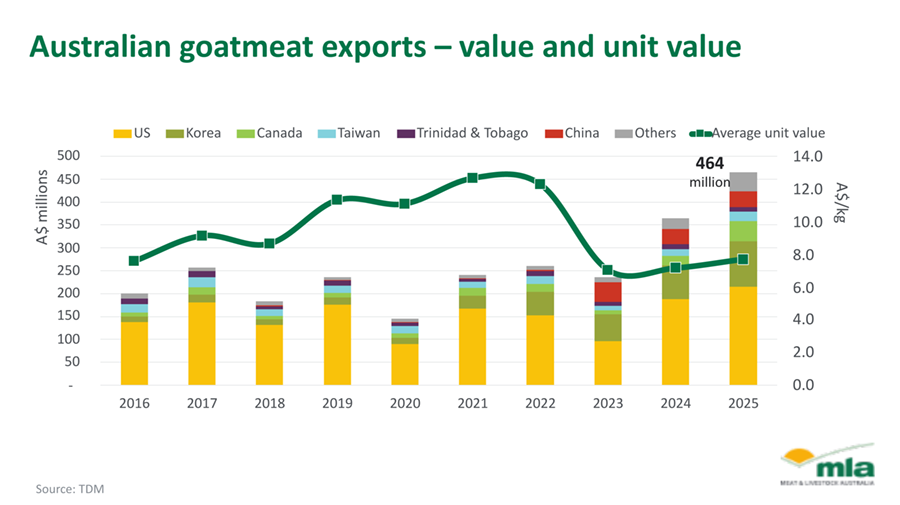
The US continued to be Australia’s largest single goatmeat export market, taking 29,649 swt in 2025 (48% of total exports). While the US remains the dominant destination, exports are becoming more diversified due to the strong growth of alternative markets. Korea was Australia’s second-largest market, with exports increasing 23% YoY to 10,638 tonnes. Mainland China remained the third-largest market at 5,449 tonnes, while Canada became the fourth-largest market, reaching 4,973 tonnes after an 89% increase in 2024.
Domestic market shows gradual development
While exports account for most Australian goatmeat production, the domestic market is also developing. Goatmeat remains a smaller part of Australian household cooking and has lower awareness and availability than other proteins. However, increased production over the past five years has improved domestic availability, with more than 10,000 tonnes carcase weight equivalent (cwe) remaining in Australia. More consistent presence of goatmeat in retail and foodservice is gradually supporting domestic market development.
The domestic opportunity is closely linked to Australia’s growing multicultural population and communities where goatmeat is already part of established food traditions. Goatmeat remains strongly associated with slow, wet cooking methods, cultural cuisines and consumer interest in health, sustainability and differentiated protein options.
More detail on production, slaughter, exports, key markets, domestic utilisation and consumer trends is available in MLA’s new Global Goat Snapshot.
Attribute content to: Emiliano Diaz, MLA Senior Market Information Analyst.
Information is correct at time of publication on 27 May 2026.
MLA makes no representations as to the accuracy, completeness or currency of any information contained in this publication. Your use of, or reliance on, any content is entirely at your own risk and MLA accepts no liability for any losses or damages incurred by you as a result of that use or reliance. No part of this publication may be reproduced without the prior written consent of MLA. All use of MLA publications, reports and information is subject to MLA’s Market Report and Information Terms of Use.
Source:MLA

