

核心要点
遗传选育、繁育技术与牛群管理水平的长期提升,持续增强澳大利亚牛群的生产能力。
繁育牛群年轻化,加上肉牛育肥周转速度加快,意味着无需长期存栏大量牛只。
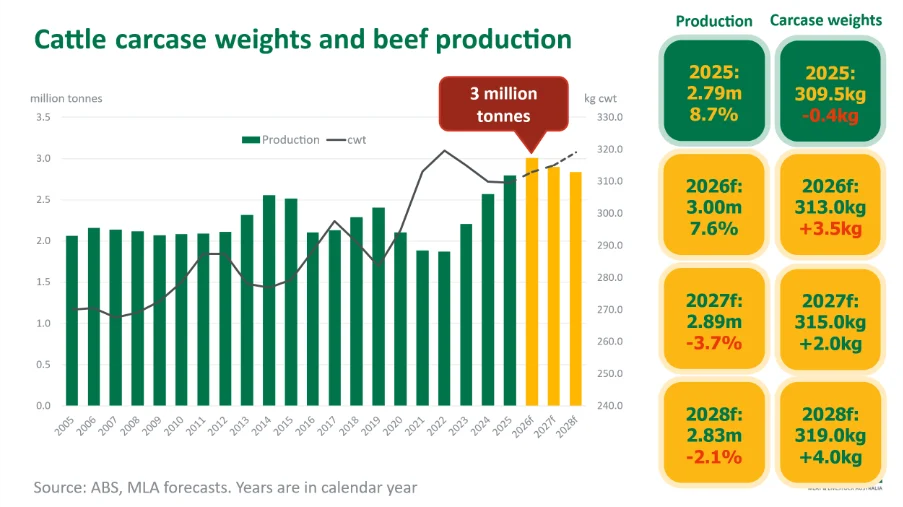
这些效率提升,支撑2026年牛肉产量突破300万吨,创下新高。
澳大利亚牛群规模将进入逐步收缩阶段,但支撑生产的体系和以往牛周期相比已大不相同。
澳大利亚肉类与畜牧业协会(MLA)9月牛业预测报告估算,2026年全国牛群存栏约3080万头,到2028年将小幅回落至略低于3000万头。尽管存栏下降,牛只出栏量预计仍维持历史高位。
理解这一看似矛盾现象的核心在于生产效率。澳洲养殖户正不断提升繁育牛群产出,同时加快牛只在生产体系内的周转效率。
繁育牛群的长期投入
生产效率的提升并非一蹴而就。
数十年来,行业围绕繁殖能力、生长速度、同龄体重以及胴体品质开展遗传选育,同时持续优化牛群管理、营养供给与基础设施,提升了牛群产能。
过去五年,尤其是在澳大利亚北部地区连续经历风调雨顺的牧季之后,上述成效愈发凸显。
在北部部分牛群中引入和牛血统,配合长期的遗传选育工作,就是养殖户逐步改良牛群基因、兼顾肉质与繁殖性能的典型案例。
加之繁育管理优化,以及适宜气候提高犊牛成活率,养殖户得以更有选择性地留存母牛。
淘汰母牛价格向好,也为养殖户创造机会:出售老龄、空怀或生产性能低下的母牛,替换为年轻后备母牛。
这推动繁育种群逐步向年轻化、高产能方向转型,而非单纯依靠增加母牛存栏来维持产量。
最终实现繁育牛群产能提升,生产水平更多取决于单头牛的生产效率,而非农场牛只存栏总量。
周转更快的生产体系
另一项重大转变,是牛只从出生到出栏所需周期缩短。
育成养殖与育肥场产能提升,叠加生长速度、同龄体重指标改善,以往还需在草场多放养一季的阉牛,如今可更早进入育肥环节。
育肥场规模持续扩张是这一趋势的核心推手,场内牛只12个月出栏量首次突破400万头。
生产效率提升对养殖户意义重大。
育肥牛提前出栏,能够减少草场压力,可留出牧草供给繁育母牛;养殖户得以饲养产能更高的牛群,而非单纯扩大存栏规模。
这一变化在澳大利亚北部尤为明显。
在昆士兰州与北领地,犊牛占牛群比例由27%提升至30%,繁育母牛占比从48%升至50%。
与此同时,其余类型牛只占比由25%下降至19%。
这正在改变牛群存栏量与牛肉产量之间的关联逻辑。
对养殖户而言,收益十分显著:繁育母牛群产出更多犊牛,单头牛产肉量提升,牛只从出生到出栏的饲养天数缩短。
即便牛群存栏有所下降,依托上述多项生产效率改进,澳大利亚牛肉年产量仍可突破300万吨。
澳大利亚肉类与畜牧业协会(MLA)不对本刊物所载任何信息的准确性、完整性及时效性作出任何保证。用户使用或依赖本刊物任何内容,风险自行承担;因使用或依赖相关信息所造成的任何损失与损害,MLA概不承担任何责任。未经MLA事先书面许可,本刊物任何内容不得擅自转载、复制。凡使用MLA刊物、报告及相关信息,均须遵守MLA市场报告及信息使用条款。
消息来源:MLA
More beef from fewer cattle: how productivity is reshaping the herd
Key points
Long-term improvements in genetics, reproduction and herd management are increasing the productive capacity of the Australian cattle herd.
A younger breeding herd and faster movement of cattle through finishing systems mean fewer cattle need to be carried for extended periods.
These efficiency gains are helping underpin record beef production of more than 3 million tonnes in 2026.
Australia’s cattle herd is entering a period of gradual contraction, but the production system supporting it looks very different to previous cattle cycles.
MLA’s September Cattle Industry Projections estimate the national herd at approximately 30.8 million head in 2026, before easing to just under 30 million by 2028. Despite the decline, cattle turn-off is expected to remain historically high.
The key to understanding this apparent contradiction is productivity. Australian producers are increasingly generating more output from the breeding herd while moving cattle through the production system more efficiently.
Long-term investment in the breeding herd
The productivity gains have not occurred overnight.
Decades of genetic selection for fertility, growth, weight-for-age and carcase performance, alongside improvements in herd management, nutrition and infrastructure, have increased the productive capacity of the herd.
These gains have become increasingly evident over the past five years, particularly across northern Australia, following several consecutive favourable seasons.
The introduction of Wagyu bloodlines into segments of the northern herd, alongside broader long-term genetic selection, is one example of how producers have progressively adapted herd genetics to target meat quality while also improving reproductive performance.
Combined with better reproductive management and improved calf survival through favourable seasons, these changes allow producers to be more selective about the females they retain.
Strong cull cow values have also provided an opportunity to turn off older, empty or lower-performing cows and replace them with younger heifers.
This is contributing to a gradual shift towards a younger, more productive breeding base, rather than simply retaining more females to maintain production.
The result is greater productive capacity from the breeding herd with performance increasingly determined by the productivity of each animal, rather than simply the number of cattle on farm.
A faster production system
Another major shift has been a reduction in the time required to move cattle from birth to turn-off.
Greater backgrounding and feedlot capacity, combined with improved growth rates and weight-for-age, mean steers that may once have remained on grass for another season, can move into finishing systems earlier.
Growing feedlot capacity has been a key driver of this trend with more than four million head turn off over a 12-month period for the first time.
These productivity gains have important implications for producers.
Moving finishing cattle through the system earlier can reduce competition for pasture, potentially freeing up feed for breeders and allowing producers to carry a more productive herd rather than simply a larger one.
The shift is particularly evident in northern Australia.
In Queensland and the NT, calves now account for 30% of the herd, up from 27%, while breeders have increased from 48% to 50%.
Simultaneously, the proportion of other cattle fell from 25% to 19%.
This is changing the relationship between herd size and beef output.
For producers, the gains are clear: more calves from the breeding base, more kilograms produced per animal and fewer days from birth to turn-off.
Together, these productivity improvements are helping Australian beef production exceed three million tonnes annually, even as herd numbers ease.
Access the full report here MLA’s September Cattle Industry Projections.
Stay ahead of the market. Join MLA's Market Information team on 7 October 2026 at 11am for an in-depth look at the latest Sheep Projections and the key drivers influencing flock numbers, production, slaughter and exports over the coming years.
MLA makes no representations as to the accuracy, completeness or currency of any information contained in this publication. Your use of, or reliance on, any content is entirely at your own risk and MLA accepts no liability for any losses or damages incurred by you as a result of that use or reliance. No part of this publication may be reproduced without the prior written consent of MLA. All use of MLA publications, reports and information is subject to MLA’s Market Report and Information Terms of Use.
Source:MLA

