

核心要点
2026年前九个月,育肥场出栏量达312万头,同比增长15%。
育肥场出栏量占成年牛屠宰总量的42.7%,高于2025年同期的38.9%。
全国育肥场存栏率91.5%,新南威尔士州贡献了过去一年三分之二的育肥场产能增量。
育肥场产能持续扩张,谷饲牛在澳大利亚牛肉供应中的占比不断提升,全国肉牛总屠宰量创下1978年以来新高。
澳大利亚育肥场协会(ALFA)与澳大利亚肉类与畜牧业协会(MLA)全国认证育肥场调查显示:2026年前九个月,育肥场出栏量同比上涨15%(增加408624头),达到312万头,刷新纪录。
澳大利亚统计局(ABS)数据显示,同期成年牛屠宰量增长4.7%,至731万头。
育肥场出栏增幅高于成年牛屠宰总量增幅,说明今年全国屠宰量的增量全部来自谷饲牛,非谷饲牛屠宰量同比下降。
屠宰量增量更多来自谷饲牛
2026年前九个月,育肥场出栏量占成年牛屠宰总量的42.7%,高于去年同期的38.9%,为2022年以来同期最高占比。
这反映出上半年国际市场对谷饲牛肉需求旺盛,同时昆士兰州与新南威尔士州部分地区的气候条件影响了草饲牛产出。
2022年同期占比更高,达48.4%,但当时总屠宰规模仅439万头,基数小很多。
2026年9月当季增速有所放缓。总屠宰量同比仅增长0.6%,至249万头;育肥场出栏量增长6.6%,至1026366头,占成年牛屠宰量的41.2%。
全年来看,育肥场持续向加工厂稳定供牛,支撑了2026年较高的屠宰规模。
9月季度,两大肉牛育肥主力州表现突出。
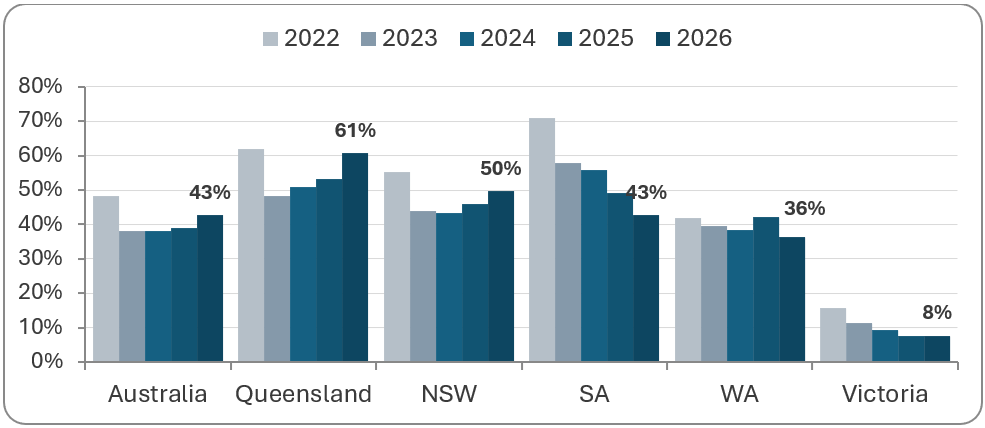
昆士兰州育肥场出栏占成年牛屠宰量的56.4%,高于上年同期52.6%;新南威尔士州占比从48.4%升至50.7%,南澳州和西澳州占比则有所回落。
2022–2026年1–9月各州育肥场出栏量占成年牛屠宰量比重
来源:澳大利亚育肥场协会(ALFA)
新南威尔士州率先扩大育肥栏位供给
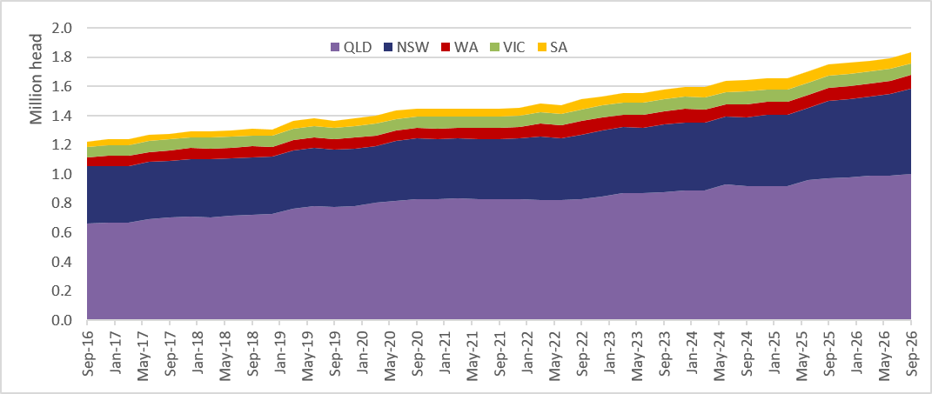
育肥场产能持续扩张,9月季度产能达到183.4万头的历史新高,同比增长4.9%。
过去一年新增产能中,新南威尔士州占比约三分之二。
各州育肥场产能
来源:澳大利亚育肥场协会(ALFA)
昆士兰州仍是行业支柱,产能接近100万头,占全国总量一半以上。
但新南威尔士州产能增速更快,过去五年其全国产能占比由29%提升至32%。
栏位需求旺盛,全国育肥场利用率达91.5%。昆士兰州育肥场利用率高达97.5%,接近满负荷,若无新增投入,难以继续增牛。
出栏量创新高、饲养周期拉长、栏位持续扩容,多重因素推动谷饲牛在澳洲牛肉供应中的占比不断提升,新南威尔士州正成为增长主力。
育肥场出栏纪录迭出、产能持续扩张,正在改变澳洲肉牛产业链的流转模式。
澳大利亚肉类与畜牧业协会(MLA)11月肉牛养殖户意向调查,可供养殖户反馈气候条件与市场信号对牛群规划、出栏决策的影响。
供稿:埃米利亚诺·迪亚兹,澳大利亚肉类与畜牧业协会(MLA)高级市场信息分析师。
信息截至2026年11月20日撰稿时准确。
澳大利亚肉类与畜牧业协会(MLA)不对本刊物所载任何信息的准确性、完整性及时效性作出任何保证。用户使用或依赖本刊物任何内容,风险自行承担;因使用或依赖相关信息所造成的任何损失与损害,MLA概不承担任何责任。未经MLA事先书面许可,本刊物任何内容不得擅自转载、复制。凡使用MLA刊物、报告及相关信息,均须遵守MLA市场报告及信息使用条款。
消息来源:MLA
Feedlots fill as grainfed turn-off reaches a record
Key points
Feedlots turned off a record 3.12 million head in the first nine months of 2026, up 15% year-on-year.
Feedlot turn-off was equivalent to 42.7% of adult cattle slaughter, up from 38.9% in the same period of 2025.
Feedlots are 91.5% full nationally, with NSW accounting for two-thirds of the growth in feedlot capacity over the past year.
Feedlot capacity continues to expand with grainfed cattle accounting for a growing share of Australia’s beef supply as total cattle slaughter reaches its highest level since 1978.
Feedlot turn-off rose 15% (408,624 head) year-on-year to a record 3.12 million head in the first nine months of 2026, according to the Australian Lot Feeders’ Association (ALFA) and Meat & Livestock Australia (MLA) National Accredited Feedlot Survey.
Over the same period, adult cattle slaughter rose 4.7% to 7.31 million head, according to the Australian Bureau of Statistics (ABS).
The increase in feedlot turn-off exceeded the rise in adult cattle slaughter, which suggests grainfed cattle accounted for all this year’s growth in national throughput, while non-grainfed cattle slaughter declined year-on-year.
More of the throughput increase is coming off grain
Feedlot turn-off was equivalent to 42.7% of adult cattle slaughter in the first nine months of 2026, up from 38.9% a year earlier and the highest share for the period since 2022.
This reflects strong international demand for grainfed beef in the first half of the year and the impact of seasonal conditions on grassfed production in parts of Queensland and NSW.
The 2022 share was higher at 48.4%, but it came from a much smaller throughput of 4.39 million head.
Growth slowed in the September 2026 quarter. Total slaughter rose just 0.6% year-on-year to 2.49 million head, while feedlot turn-off rose 6.6% to 1,026,366 head, equivalent to 41.2% of adult cattle slaughter.
Feedlots have provided a steady flow of cattle to processors through the year, helping to underpin the strong throughput recorded in 2026.
The two biggest feeding states led the way in the September quarter.
In Queensland, feedlot turn-off was equivalent to 56.4% of adult cattle slaughter, up from 52.6% a year earlier. In NSW, the share rose to 50.7% from 48.4%, while it eased in SA and WA.
Feedlot turn-off as a share of adult cattle slaughter by state, January - September 2022–2026.
Source: ALFA.
NSW leads the push for more pen space
Feedlot capacity continued to expand, reaching a record 1.834 million head in the September quarter, 4.9% more than a year earlier.
NSW accounted for around two-thirds of the additional capacity over the past year.
Feedlot capacity by state
Source: ALFA.
Queensland remains the backbone of the sector, with close to 1 million head of capacity, more than half the national total.
However, NSW capacity has grown faster, lifting its share of the national total from 29% to 32% over the past five years.
Demand for that space remains strong with national utilisation at 91.5%. Queensland feedlots are operating close to full at 97.5%, leaving little room for more cattle without further investment.
Together, record turn-off, longer feeding and growing pen space mean grainfed cattle are supplying a larger share of Australia’s beef, with NSW increasingly setting the pace.
Record feedlot turn-off and expanding capacity are changing how cattle move through Australia’s production system.
MLA’s November Beef Producer Intentions Survey provides producers with an opportunity to share how seasonal conditions and market signals are influencing their own herd and turn-off decisions.
Attribute content to: Emiliano Diaz, MLA Senior Market Information Analyst.
Information is correct at time of writing on 20 November 2026.
MLA makes no representations as to the accuracy, completeness or currency of any information contained in this publication. Your use of, or reliance on, any content is entirely at your own risk and MLA accepts no liability for any losses or damages incurred by you as a result of that use or reliance. No part of this publication may be reproduced without the prior written consent of MLA. All use of MLA publications, reports and information is subject to MLA’s Market Report and Information Terms of Use.
Source:MLA

